
For claims professionals and nurse case managers, managing complex cases often means navigating mobility limitations that affect daily living. Home and vehicle modifications aren’t optional add-ons, they’re essential tools that promote recovery, reduce re‑injury risks and support a smoother return to work. This article explores the process, benefits and best practices, drawing from industry insights and the Comp‑X approach.
Why modifications matter in workers’ comp claims
Severe injuries such as spinal cord damage, traumatic brain injuries or amputations often require environmental adjustments to support long‑term independence. Industry research shows that medical costs in workers’ compensation continue to rise, and fee schedule updates influenced by Medicare can affect reimbursement for ancillary services like modifications. This makes it increasingly important to partner with vendors who ensure modifications are medically necessary, compliant and cost‑effective.
Reports from NCCI and WCRI highlight how fee schedule changes and reimbursement structures impact ancillary services. For claims professionals, this underscores the value of working with providers who understand regulatory requirements, follow ADA guidelines and deliver modifications that support claim resolution, not complicate it
The home modification process: from assessment to completion
Home modifications can range from simple additions like grab bars and lift chairs to major renovations such as ramps, widened doorways, or bathroom remodels. The goal is always the same: enable safe, independent daily living and reduce the risk of re‑injury.
At Comp‑X, the process begins with a comprehensive assessment. We assemble a team of construction and rehabilitation experts who collaborate with our specialized care coordinators, supported by clinical oversight from our clinical director, a certified case manager and registered nurse. Only licensed, bonded, and insured contractors are used to ensure quality and reduce liability. All recommendations undergo review for medical necessity and fair pricing.
A key step is the live video assessment, involving the injured worker, caregiver, contractor, and claims team. This collaborative approach provides accurate progress reports and helps catch issues early. Once complete, we conduct an injured worker satisfaction review to confirm usability and quality.
Industry best practices emphasize the importance of early evaluation, clear communication, and strong project coordination, areas where Comp‑X excels through our U.S.-based team and 24/7 support.
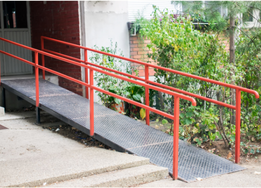

Examples of accessible home ramp (permanent and temporary), enabling safe entry for wheelchair users.
Vehicle modifications: ensuring safe mobility on the road
Vehicle modifications are equally critical for workers regaining independence. These can include left-foot accelerators, hand controls, or ramps for wheelchair access, helping injured employees return to driving and work.
We begin with an assessment by a driver rehabilitation specialist. This includes visual, perceptual, and cognitive screenings, plus evaluations of wheelchair seating and driving capabilities with adaptive equipment. Once approved, we perform a full vehicle fitting and apply modifications.
Throughout, our team oversees compliance with ADA, Certified Aging-in-Place Specialists (CAPS), and National Association of Home Builders (NAHB) standards. This helps to ensure modifications are appropriate, cost-effective, and safe.
Best practices across the industry highlight the importance of early intervention, thorough documentation, and the use of virtual tools to streamline assessments, all of which support better outcomes and faster return‑to‑work timelines.
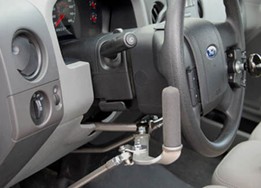
Vehicle hand controls, a common adaptation for drivers with mobility challenges.
Partnering with Comp-X for seamless solutions
At Comp-X, we’re more than a vendor, we’re an extension of your team. Our nationwide network, direct contracting, and focus on prospective care management mean faster resolutions and fewer disputes. We handle everything from permits to certifications, ensuring compliance and cost control.
As a certified MWBE, we’re committed to delivering reliable, U.S.-based support without the hassles of overseas call centers. Claims professionals and nurse case managers appreciate our accessibility, even after hours, and our dedication to quality outcomes.
Comp-X believes life begins at home. Let us help restore that for the injured workers you serve.
Ready to simplify your next modification referral? Contact us at 1-888-777-9022 or [email protected] to get started.